The Nikon Z8 is a high-end full-frame mirrorless camera built for photographers and hybrid shooters who want flagship-level Nikon performance without the size of the Z9. Nikon calls it a compact follow-up to the Z9 and a true successor to the D850, and that’s pretty accurate.
Quick Verdict
The Nikon Z8 is one of the best cameras Nikon has ever made, and I think it is the best overall full-frame camera on the market today. It gives you flagship autofocus, a 45.7MP stacked sensor, excellent video capability, and a body that is far more manageable than the Z9. The only real problem is price but even then its less expensive than other comparable cameras.
This is not the camera for casual shooters. But if you want a serious high-end Nikon body for professional stills, wildlife, sports, commercial work, it’s the easiest camera in the class to recommend. Buy the Z8 if you want near-flagship Nikon performance without the Z9’s bulk.
Nikon Z8
The best overall full-frame camera on the market today for buyers who want elite image quality, resolution, speed, autofocus, and genuinely excellent handling in one body.
Who is this for?
Wildlife shooters, sports photographers, wedding shooters, commercial users, and serious hybrid creators.
Worth getting?
Yes, if you actually need the Z8’s class-leading speed and high-resolution performance.
Check Price on Amazon Check Price at Adorama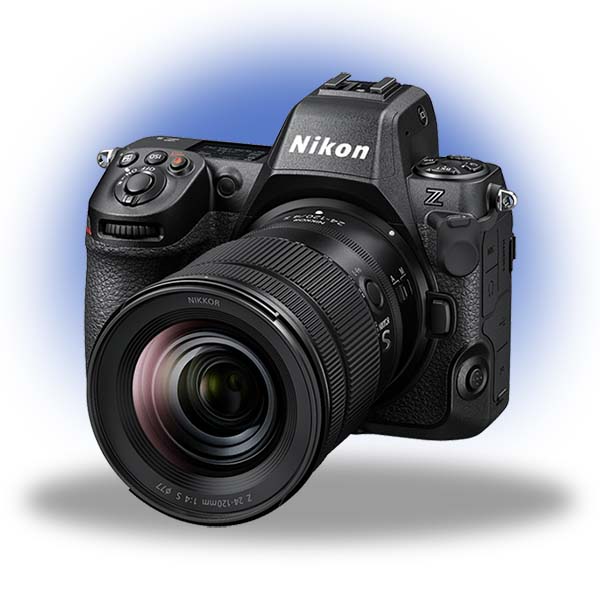
Key Features
The Z8 is built around Nikon’s stacked 45.7MP full-frame sensor and flagship-level autofocus system. That combination gives it the kind of speed and responsiveness that makes it useful for action while still delivering the high resolution commercial and landscape shooters want.
This is what makes the Z8 so compelling. Most cameras make you choose between speed and resolution. The Z8 gives you a lot of both, and it layers in the rest of what a flagship should have: internal 8K/60p, in-body stabilization, a fully electronic shutter with no mechanical backup, and a blackout-free viewfinder.
It is also one of Nikon’s strongest examples of why the Z system is so appealing right now. The camera is excellent on its own, but it becomes even more convincing when you pair it with Nikon’s lens system.
Z8 Tech Specifications
- Lens Mount: Nikon Z
- Megapixels: 45.7
- Sensor Size: Full-Frame (35.9 x 23.9mm) stacked CMOS
- Sensitivity Range: ISO 64 to 25,600 (expands to 32 to 102,400)
- Autofocus System: 493-point hybrid AF with subject detection, 3D tracking, and approximately 90% frame coverage
- Continuous Shooting Speed: Up to 20 fps RAW, up to 120 fps 11MP JPEG
- Monitor: 3.2-inch vertical and horizontal tilting, 2.088m dots
- Max Shutter Speed: 1/32,000 sec.
- Buffer: 1000+ frames (when shooting only to XQD/CF Express)
- Stabilization: 5-axis in body
- Viewfinder: EVF 3.69m dots, 100% coverage, .8x magnification
- Max video resolution: 8K up to 30p, 4K up to 120p (no crop)
- Memory Card: 2 slots (1 XQD/CFexpress and 1 SD/SDHC/SDXC UHS-II)
- Dimensions: (W x H x D): 144 x 118.5 x 83 mm / 5.7 x 4.7 x 3.3″ inches
- Weight (battery incl.): 910g / 32.1oz
Sections In This Review:
- Ergonomics And Handling
- Build Quality
- Image Quality
- Dynamic Range
- Low-Light Performance
- Screen And Viewfinder
- Lens Mount And Compatibility
- Autofocus Performance
- Video Features
- Battery Life
- Connectivity
- Pros And Cons
- Rating Breakdown
- Value And Competition
- Final Verdict
- Related Articles
Ergonomics And Handling
This is one of Nikon’s biggest strengths. The Z8 is not small, but it handles extremely well for the kind of camera it is, and that ease of use is a major part of why I rate it so highly overall.
It is 30% smaller than teh Z9 and 15% smaller than the old D850 (which was my go to camera for professional work for years).
I still think Nikon has the best ergonomics among the major brands, and the Z8 is one of the clearest examples. It feels like a serious camera, but not an unnecessarily bulky one. Nikon did a very good job shrinking the Z9 idea into a body more photographers will actually want to carry.
Compared to the Sony A7R V, this feels much more natural in the hand. Compared to the Canon EOS R5 Mark II, I still think Nikon has a slight edge in overall usability.
Build Quality
The Z8 feels professional. This is not a mid-range body pretending to be something more. It is built for people who actually shoot a lot, often in less-than-perfect conditions.
The shell uses a magnesium alloy front plate to hold the lens mount and sensor in precise alignment, paired with a carbon-fiber reinforced composite (widely believed to be Teijin’s Sereebo) for the rest of the body. That combination is how Nikon shaved the weight compared to the Z9 without giving up rigidity. Nikon also rates the weather sealing at the same level as the Z9, with seals behind every joint, button, and dial.
In practice, that claim holds up. Reviewers have put the Z8 through rain, cold, and rough terrain with no issues, and nothing about the body makes me question how it will hold up over a career of real use.
It does not feel cheap anywhere, and it gives exactly the kind of confidence you want from a camera at this level.
Image Quality
Image quality is excellent. The 45.7MP stacked sensor delivers the kind of detail, flexibility, and overall file quality you would expect from a high-end Nikon body.
DXOMark scores the Z8 sensor at 98 overall, which essentially ties the Z9 and puts it in the same conversation as the Sony A1 and A7R V. Color depth measures 26.3 bits at ISO 64, which is about as good as full-frame gets. The Sony A7R V edges the Z8 slightly in pure color response (roughly 1 bit in some ISO ranges) and in low-light sensitivity (around half a stop), but the margin is small enough that in real files I doubt many buyers would pick it out.
Nikon is right there with Sony at the top end of image quality, and the Z8 does nothing to weaken that argument. If anything, it reinforces it.
The files are large, of course, and that is part of the cost of this kind of camera. But if you actually need this level of resolution, the Z8 is incredibly convincing.

Dynamic Range
Dynamic range is one of the Z8’s strengths. At base ISO 64 the sensor delivers around 14.2 EV of dynamic range per DXOMark, which is as good as anything in the full-frame class and one of the practical benefits of Nikon’s low base ISO. Photons to Photos data on the Z8 tracks closely with the Z9 across the ISO range, which is expected since the two cameras share the same stacked sensor.
The Z8 uses dual-gain conversion, which creates a subtle but real wrinkle worth understanding. Dynamic range declines at roughly 1 EV per stop of ISO through around ISO 400, bottoming out near 11.8 EV, before the second gain step engages between ISO 400 and ISO 800 and lifts it back up to about 12.6 EV. If you find yourself in that range often, the practical tip is to jump straight to ISO 500 rather than sit at ISO 400, since ISO 500 gives noticeably cleaner shadows for very little loss in highlight headroom.
The files are flexible, editing latitude is strong, and the camera gives you the kind of RAW headroom high-end buyers will expect. This is one of the reasons the Z8 works for both fast action and slower, detail-critical photography.
Low-Light Performance
Low-light performance is strong, though this is still a 45.7MP stacked sensor and it behaves like one. DXOMark rates the Z8 at ISO 2548 in its sports (low-light) score, which is a very solid number but sits slightly behind the best dedicated low-light sensors in the class.
In practical shooting, the Z8 is essentially noise-free through ISO 800, shows the first hint of luminance noise at ISO 1600, and is still clean enough to use at ISO 3200. Files hold up respectably through ISO 6400, and ISO 12,800 is usable for casual work, especially if you are running modern AI noise reduction on the back end. That is a realistic working range for a high-resolution stacked sensor. The second dual-gain step at ISO 500 is also worth keeping in mind since it is one of the cleanest ISOs on the camera for low-light shooting.
The stacked sensor design does cost you a small amount of noise compared to a more conventional sensor or a back side illuminated sensor, and that is worth being honest about. The Z8 does well in low light, but it does not have the same naturally easy low-light balance as the Z6III.
That is not a criticism so much as a reminder that every camera is a tradeoff. If your biggest priority is low-light balance and file efficiency, the Z6III may actually make more sense. If you need both speed and resolution, the Z8 is the better fit.

Screen And Viewfinder
The viewing experience is excellent. Nikon’s Real-Live Viewfinder is a 3.69M-dot OLED panel that runs up to 3000 nits of peak brightness with zero blackout, which is a standout feature of this camera. The body also includes a 3.2-inch 4-axis tilting monitor with about 2.1 million dots. The 3000-nit brightness in particular makes a real difference in bright daylight, where most EVFs start to wash out.
This is one of those areas where Nikon feels like it really understands working photographers. The Z8 does not just look strong on paper. It feels well thought out in use.
Compared with the Sony A7R V, the Z8 is more speed-oriented and more immediate in use, while Sony leans harder into resolution-first flexibility. Compared with the Canon EOS R5 Mark II, the Z8 sits in the same high-end conversation but feels especially convincing if you value Nikon handling and Nikon’s viewfinder behavior.
Lens Mount And Compatibility
The Z8 uses the Nikon Z mount, and I still think that is one of Nikon’s biggest system advantages. The short flange distance and mount design have helped Nikon create some of the best modern mirrorless lenses on the market.
That matters even more on a camera like this because a high-end body only really pays off when the lens system around it is equally convincing. Nikon delivers that.
The FTZ adapter also keeps the Z8 attractive for long-time Nikon DSLR users moving over from F mount.
Autofocus Performance
Autofocus is one of the Z8’s biggest strengths. Nikon built this around a 493-point hybrid system covering roughly 90% of the frame, and it uses the same higher-end autofocus logic as the Z9. Subject detection handles nine categories — people (including eyes, faces, heads, and torsos), dogs, cats, birds, other animals, cars, motorcycles, bicycles, trains, and airplanes — and in practice you can leave the camera on 3D tracking for most shooting and it just works. You place the point on your subject, hit AF-On, and the Z8 stays locked on as they move through the frame.
Real-world performance is strong but not infallible. The system can occasionally lock onto a reflection instead of the bird sitting on the water, or jump from one player to another in sports when a color shift or overlap confuses it. That kind of behavior is not unique to Nikon though. Firmware updates from v2.0 onward have meaningfully tightened up bird detection and added Auto Capture, and the system today is noticeably better than it was at launch.
Against the competition, Canon and Nikon have largely caught up to Sony, and the gap is now small enough that subject detection and eye detection are closer to a wash across all three. The Sony A1 arguably still has the slightest edge in pure stickiness, and the Canon R5 Mark II adds a RAW pre-capture buffer that the Z8 only matches in JPEG. The Sony A7R V has great autofocus on paper but is held back for action by a 6 fps cap on full-quality RAW, so the Z8 genuinely pulls ahead for wildlife and sports buyers who need both resolution and speed. Nikon is fully credible at this level.
Video Features
The Z8 is a serious hybrid camera. Internally it records 12-bit N-RAW and ProRes RAW HQ, along with 10-bit ProRes 422 HQ and H.265 (plus 8-bit H.264 when a lighter workflow is all you need). N-RAW goes up to 8.3K at 60p and 4.1K at 120p, and the camera can hold 8K UHD/30p for up to 90 minutes or 4K UHD/60p for up to 125 minutes continuously. Full-frame 4K/120p with no crop is the spec that sells the hybrid story, since very few cameras give you that without a sensor-area penalty.
For grading and delivery, the Z8 offers N-Log, a Flat profile, and HLG for HDR-ready output straight out of the camera. Combined with the full-size HDMI, the internal RAW options, and the dual-SD/CFexpress slots for safe long recordings, the Z8 is genuinely built for shooters who care about both stills and video. If you want a true all-in-one high-end camera, the Z8 makes a very strong case.
Battery Life
Battery life is good enough for the class, though not the reason to buy the camera. Nikon rates it at about 340 shots with the EVF or 370 with the LCD when power saving is on, and about 330 and 340 respectively when it is off. Nikon also rates video recording at about 125 minutes.
This is one of the few areas where the smaller body does not come free compared to the Z9.
Still, for most real buyers, the battery situation is fine. The Z8 also supports USB-C charging and power delivery in-camera, so a USB-C PD power bank or AC adapter can keep the camera running during long shoots or tethered sessions, which takes some of the sting out of the CIPA numbers. Compared with the Sony A7R V and Canon EOS R5 Mark II, the Z8 is in the same practical professional class, even if you still should not expect all-day endurance without planning around it.
Connectivity
Connectivity is one of the quieter strengths of the Z8. The body includes two USB-C ports (one for data and tethering, one dedicated to power and charging), a full-size HDMI Type A output, 3.5mm microphone and headphone jacks, and Nikon’s 10-pin remote terminal. Wireless is handled by dual-band 802.11ac Wi-Fi and Bluetooth 5.0 LE, with SnapBridge for pairing to a phone. Wired Ethernet is available via a USB-C to 1000BASE-T adapter for FTP transfer in the field.
The full-size HDMI is a real differentiator at this level since several competing bodies went to mini or micro, and the dual USB-C setup makes tethered shooting and long-form video a lot more practical than it sounds on paper. For the photographers this camera is aimed at, the I/O situation is one fewer compromise to work around.
Pros And Cons
Pros
- Outstanding autofocus and overall performance
- Excellent 45.7MP stacked sensor
- Much smaller than the Z9 while keeping most of the appeal
- Exceptional professional build quality
- Very serious hybrid photo and video camera
- Full-size HDMI and dual USB-C for serious tethering and long-form video
- No mechanical shutter means no shutter-count ceiling
Cons
- Expensive
- 45.7MP is overkill for many buyers
- Heavier and more specialized than the Z6III
- Not the best value if you do not need this level of performance
Rating Breakdown
- Image Quality: 9.5/10
- Autofocus: 9.6/10
- Ergonomics And Handling: 9.8/10
- Build Quality: 9.6/10
- Video Features: 9.5/10
- Lens Ecosystem: 9.4/10
- Value: 9.0/10
- Overall Appeal: 9.2/10
Final Rating: 9.5/10
Value And Competition
The Z8 is expensive, but I still think it is one of the best value propositions in the high-end full-frame market because you genuinely get what you pay for and it still comes in below some of the other cameras in this class.
Against the Nikon Z6III, the Z8 gives you much more resolution, more high-end speed, and a more professional overall package. Against the Nikon Z9, it gives you most of the flagship appeal in a smaller and more realistic body for many photographers. Against the Sony A7R V, the Z8 gives you a more speed-oriented high-resolution camera. Against the Canon EOS R5 Mark II, it lands in the same high-end hybrid conversation.
If you need a camera that can legitimately handle wildlife, sports, weddings, commercial work, and serious video, the Z8 is the best overall full-frame camera on the market today in my view. That comes from the combination of image quality, resolution, speed, autofocus, and how exceptionally well the body feels in the hand. If you do not need all of that, the Z6III is probably the smarter buy. And if you are considering the Z9, the Z8 is the camera I think many people should buy first unless they specifically need the integrated flagship body.
Final Verdict
The Nikon Z8 is one of Nikon’s best cameras and, in my view, the best overall full-frame camera on the market today.
I would not recommend it to everyone, but I would absolutely recommend it to the right buyer. If you need what the Z8 offers, it is easy to defend. If you do not, buy the Z6III and save the money. For a lot of photographers who would otherwise think about a Z9, I also think the Z8 is the smarter place to stop.

Why Trust Me?
My name is Pete and I’m professional photographer and the person behind Photography Goals. I spend a lot of time comparing and researching cameras, lenses, and other gear, and my goal is to give practical recommendations based on real-world use, value, and what makes sense for your needs, not just show you spec sheets.
Related Articles
- Best Lenses For the Nikon Z8
- Nikon Z6III Review (coming soon)
- Canon EOS R5 Mark II Review (coming soon)
- Sony A7R V Review (coming soon)
