Overview
The R50 is a crop sensor camera with a number of high end features that makes it a lighter and more affordable option than some of the other more expensive Canon cameras while still giving you great results.
The Canon EOS R50 is ideal for enthusiasts, creators, and upgraders who want professional results without the complexity or weight of a full-frame system.
Perfect for:
- Beginners moving up from smartphones or entry-level DSLRs.
- Travel photographers and vloggers needing a lightweight camera.
- Hybrid shooters who want both photo and video flexibility.
- Content creators producing for YouTube, TikTok, or small productions.
It’s less ideal for sports photographers, professionals requiring weather-sealed bodies, or those who need advanced video tools and IBIS.
Check Price on Amazon Check Price at Adorama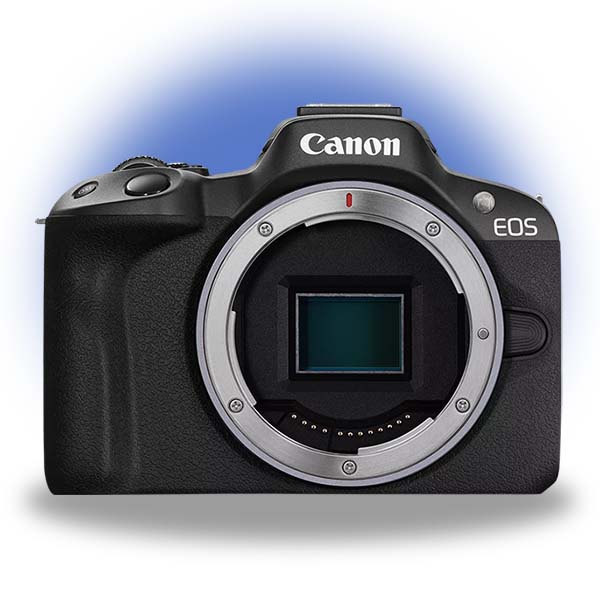
Key Features
Canon did an impressive job with the R50 at this price point. It inherits many features from
Canon’s higher-end models and delivers them in a compact, beginner-friendly package.
The 24.2 MP APS-C sensor and DIGIC X processor produce sharp images with excellent
color depth and dynamic range. The Dual Pixel CMOS AF II system, borrowed from the full-
frame R-series, offers deep learning-based subject detection that can track eyes, faces,
animals, and even vehicles.
At up to 15 fps in electronic first-curtain mode, the R50 handles fast action better than most
cameras in its class. Add uncropped 4K 30p video, and it’s clear Canon wanted to give
creators more power than the typical entry-level camera.
The only notable omission is in-body image stabilization, you’ll rely on stabilized lenses or a
gimbal for smoother handheld video.
Canon EOS R50 Tech Specifications
- Lens Mount: Canon RF
- Megapixels: 24.2
- Sensor Size: APS-C (1.6x crop) CMOS
- ISO Range: 100-32,000 (exp to 51,200)
- AF Points: Dual Pixel CMOS AF II (100% coverage)
- Continuous shooting speed: 12fps (15fps w/ electronic shutter)
- Stabilization: None
- Viewfinder: EVF, 2.36m dots, 60fps refresh rate, 0.95x magnification
- LCD: Fully Articulated 3-inch touch screen, 1.62m dots
- Max video resolution: 4K video up to 30p (no crop)
- Memory Card: 1 slot (SD/SDHC/SDXC UHS-I)
- Dimensions: (W x H x D): 116 x 86 x 69 mm (4.57 x 3.39 x 2.72″)
- Weight: 375g
Ergonomics
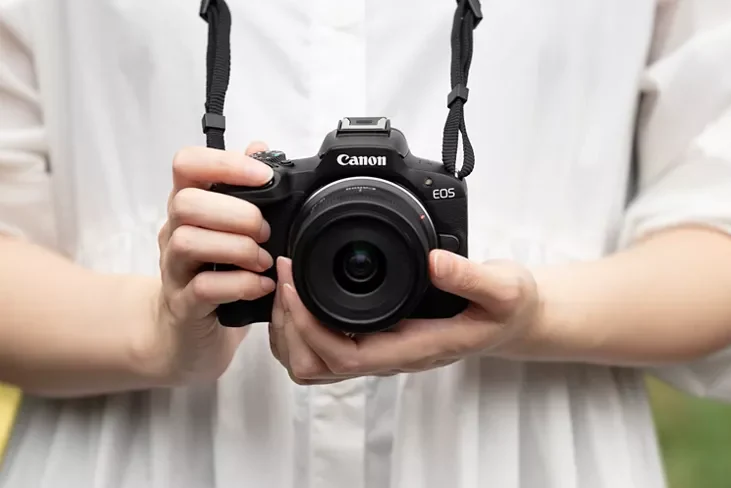
The Canon EOS R50 strikes a smart balance between portability and usability. Despite
being smaller than Canon’s older Rebel DSLRs, it feels comfortable in hand. The grip is
modest but secure, and the control layout is intuitive for newcomers.
Most reviewers describe it as light and well-balanced, ideal for all-day use or travel shooting.
The buttons and dials are logically placed, though users with larger hands might find them a
bit tight together.
The fully articulating touchscreen is a highlight, it flips forward for self-recording and can be
tilted at almost any angle. This makes it equally comfortable for vloggers, vertical video, or
creative low-angle shots.
Pros
- Excellent image quality for a crop sensor camera
- Exceptional ergonomics and usability
- Affordable entry point to Nikon Z system
Cons
- Only a few Z mount DX lenses are currently available
- Flip down screen isn’t very practical
- No mic jack for monitoring video
Build Quality
The R50’s build quality is what you’d expect from a mid-range APS-C camera: solid plastic
construction with a well-finished exterior. While it’s not weather-sealed or built for heavy
professional abuse, it feels durable enough for daily use and travel.
At just 375 g, it’s one of the lightest cameras in Canon’s mirrorless lineup. You can toss it in
a small bag and hardly notice the weight, an advantage for creators on the move.
Image Quality
The 24.2 MP APS-C sensor delivers excellent results. Images are sharp, detailed, and
exhibit Canon’s signature color science-vivid yet natural tones, particularly in skin and sky
rendering.
JPEGs straight out of the camera look great, and RAW files hold plenty of latitude for editing.
The R50’s color reproduction is consistent across different lighting conditions, which is great
for hybrid creators switching between photo and video.
Sample Images

(image credit: Canon USA)

(image credit: Canon USA)
Dynamic Range
For an APS-C sensor, the dynamic range is solid, around 13 stops in testing. That’s enough
flexibility for recovering shadows or highlights in post-processing without introducing much
noise.
You won’t get full-frame-level dynamic range, but the R50 performs very respectably for its
size and cost.
Low Light Performance
The R50 performs surprisingly well in low light thanks to its DIGIC X processor. You can
shoot comfortably up to ISO 6400 – 12800 with minimal noise and accurate color retention.
Beyond that, grain becomes noticeable, but still manageable with noise reduction in post.
For nighttime city scenes, indoor events, or concerts, it remains a capable performer
especially when paired with a fast RF or EF lens.
Screen and Viewfinder
The 2.36-million-dot OLED EVF is bright and clear, offering a smooth refresh rate for framing
and review. It’s not as large as the EVFs in Canon’s higher-end models, but it performs well
for its class.
The 3-inch fully articulating touchscreen is one of the best in this segment—responsive,
color-accurate, and easy to use in both photo and video modes. You can navigate menus,
set focus points, and control shooting modes directly from the screen.
There’s minimal blackout during continuous shooting, so you can follow moving subjects
easily through the viewfinder.
RF Mount & Lens Compatibility
The R50 uses Canon’s RF mount, meaning it’s part of Canon’s latest mirrorless ecosystem.
This opens access to all RF lenses—and with the EF-RF adapter, you can use your existing
EF or EF-S glass without performance loss.
At the APS-C level, Canon’s RF-S lens lineup is still growing. Currently, there are versatile
zoom options like the RF-S 18-45 mm kit lens and RF-S 18-150 mm, which cover most
everyday needs. As Canon expands the RF-S range, the system’s flexibility will only
increase.
Autofocus Performance
Autofocus is where the EOS R50 truly shines. The Dual Pixel CMOS AF II system offers
deep-learning subject detection for people, animals, and vehicles.
It tracks eyes and faces effortlessly, even when your subject turns or moves erratically. In
continuous AF and burst shooting, it maintains accurate focus at up to 15 fps, making it
capable of handling sports, kids, or pets with ease.
Focus acquisition is fast and reliable even in dim lighting, which helps maintain consistency
in mixed environments.
Video Features
The R50 shoots 4K 30p video with no crop, oversampled from 6K for maximum detail.
Colors look rich and natural straight out of camera—perfect for creators who want great
results without heavy grading.
It also offers Full HD 120p for smooth slow-motion footage. Rolling shutter is slightly
noticeable in fast pans, but manageable for typical handheld work.
Although there’s no IBIS, pairing the R50 with an IS-equipped lens or a compact gimbal
delivers professional-looking results.
Connectivity
The camera includes Wi-Fi and Bluetooth 4.2 for seamless image transfer to your
smartphone via the Canon Camera Connect app. You can also shoot remotely from your
phone or transfer content for instant social posting.
The USB-C port supports data transfer and charging, while the Micro-HDMI output allows
clean output for external monitors or live streaming setups.
Overall Impression
The Canon EOS R50 is a beautifully balanced camera, powerful, compact, and
approachable. It brings advanced autofocus and 4K performance from Canon’s higher-end
R-series into a body that’s easy for anyone to use.
It’s an especially great choice for creators who want better quality than a smartphone or
basic DSLR can provide, but who still value convenience and portability.
Sure, it lacks IBIS and some pro-level ergonomics, but its strengths,image quality,
autofocus, and usability. far outweigh those omissions.
In short: the Canon R50 is the camera you’ll actually carry. It’s light, capable, and creative,
a perfect gateway into Canon’s mirrorless RF system and a tool that can grow with your
skills.
