Sports is one of the most fun and exciting genres a photographer can shoot. But it also requires gear that can keep up with the speed of the action.
My top pick for the best canon camera for sports photography is the Canon R5. It has all the features you need to capture even the fastest moving sports at extremely high image quality.
Keep reading for my full breakdown of this camera and five others that might be right for you.
Photography Goals uses affiliate links. When you buy products through the links on our site, we may earn a commission.

1. Canon EOS R5
This 45 megapixel beast can keep up with the best in terms of shooting speed and autofocus and still give you high resolution images to get spectacular sports photos.
This might be a bit of a surprise for some of you that I didn’t choose the flagship R3, but hear me out.
The R3 costs about $2000 more and you’re not gaining much in terms of features that are helpful for shooting sports plus you’re losing 20 megapixels in resolution which limits your ability to crop in on the action after you take the photo.
The R5 also made my overall list of the Best Cameras For Sports Photography.
So let’s get to why I chose the R5 as the top pick. First let’s take a look at the specs…
Canon EOS R5 Tech Specifications
- Lens Mount: Canon RF
- Megapixels: 45
- Sensor Size: Full-Frame Dual Pixel CMOS
- ISO Range: 100-51,200 (expandable to 102,400)
- AF Points: Dual Pixel CMOS AF II covering Approx. 100% Area with 1,053 point AF Area (w/ Subject tracking of People and Animals)
- Continuous shooting speed: 12 fps with Mechanical Shutter (up to 20 fps Electronic (Silent) Shutter)
- Stabilization: 5 axis in body image stabilization (IBIS)
- Viewfinder: EVF, 5.76m dots, 120fps refresh rate, 0.7x magnification
- LCD: Fully Articulated 3.2-inch touch screen, 2.1m dots
- Max video resolution: 8192 x 4320 @ 30p / 4096 x 2160 @ 120p
- Memory Card: 1x SD/SDHC/SDXC UHS-II and 1x CFexpress
- Dimensions: (W x H x D): 138 x 97.5 x 88.0mm (5.45 x 3.84 x 3.46 in.)
- Weight: 738g
Those are pretty impressive overall and when it comes to the ones that count for shooting sports, the R5 has everything you need.
In terms of fast shooting, you’re getting 12 fps with the mechanical shutter and up to 20 fps with the electronic. In my experience, anything 12 or higher is plenty for shooting even the fastest moving sports and 20 fps is incredible.
While using the R5, I never felt like I was missing the shot. 12 fps was enough in many circumstances, but when I really needed the extra speed (like trying to time a batter’s swing) then the 20 fps really delivered.
Note: The actual frames per second can vary based on the lens you’re using (especially when adapting older DSLR lenses) as well as the speed of the cards you’re using. For fastest rates and minimal buffer, use a fast CFexpress card and set it to write only to that card.
But the important feature here isn’t ONLY the frame per second, it’s that you can get that fast shutter speed while using the full features of the R5 autofocus system, which up there among the industry leaders.

The R5 autofocus system has Canon’s Dual Pixel CMOS AF II system with 1053 available AF zones. The subject tracking works exceptionally well.
But aside from the specs, I found that it was easy to use and track the subject. Even with other players running in front of the subject, I was able to keep tracking the player with the ball. This is a small detail but invaluable.
Even when shooting sports where the players wear helmets, I was able to finds the heads and even detects the eyes under the helmet if the player is large enough in the frame. This is a massive upgrade from even the best Canon DSLRs, where is can be difficult to get eyes in sharp focus in similar conditions.
This is a major reason why I recommend mirrorless cameras for any kind of action shooting. The average person will get better results from a mid-range mirrorless camera than even a high end DSLR when it comes to shooting in tricky focusing situations like sports.
Ok, let’s talk a little about the downsides because no camera is perfect.
The electronic viewfinder (EVF) does have a blackout for a fraction of a second when shooting. For some, this can make it tricky to follow fast moving action. There is a “High Speed Display” mode that is available when shooting in High Speed (H) mode, but this replaces the blackout with the shot you just took so you’re still not getting a live feed from the sensor.
This is one place where the stacked sensor of the R3 does outperform the R5. It’s up to you whether it’s worth giving up 20 megapixels to get rid of the EVF blackout.
Overall, I loved this camera and it was a pleasure to shoot with. If I had to pick a Canon camera to shoot sports with, this would be the one.
But, it wouldn’t be my overall top pick for sports among all camera brands. If you’re not locked into the Canon system then you can get both (and a lot more) in the Nikon Z8 for a similar price.

2. Canon EOS R6 Mark II
Although the R6 Mk II has a lower megapixel count than the top pick above, it still shoots fast, has great autofocus, and is over $1000 less.
The Canon R6 Mark II made the second spot on my list because it gives you many of the important features you need at a price point that is far lower than the R5.
Essentially, what you are getting with the R6 Mark II is a slightly less full features camera compared to the R5.
Canon EOS R6 Mk II Tech Specifications
- Lens Mount: Canon RF
- Megapixels: 24.2
- Sensor Size: Full-Frame Dual Pixel CMOS
- ISO Range: 100-102,400
- AF Points: Dual Pixel CMOS AF II covering Approx. 100% Area with 1,053 point AF Area (w/ Subject tracking of People and Animals)
- Continuous shooting speed: 30 fps RAW burst mode with 12 fps with mechanical shutter, and up to 40 fps using electronic (silent) shutter
- Stabilization: 5 axis in body image stabilization (IBIS)
- Viewfinder: EVF, 3.69m dots, 120fps refresh rate, 0.76x magnification
- LCD: Fully Articulated 3.0-inch touch screen, 1.62m dots
- Max video resolution: 3840 x 2160 @ 60p / 1920 x 1080 @ 120p
- Memory Card: 2x SD/SDHC/SDXC UHS-II
- Dimensions: (W x H x D): 5.45 x 3.87 x 3.48 in. (138 x 98.4 x 88.4mm)
- Weight: 680g
The biggest difference is the 24.2 megapixel sensor. You’ll be giving up some ability to crop in on your shots while maintaining a high resolution.
I have been using higher resolution cameras to shoot sports and gotten used to shooting a little wider to make sure I get everything I want in the frame and then crop in later. But as long as you don’t plan to make any large prints, the lower resolution is not a major factor.
One benefit you get from having a smaller 24.2 MP file size is that this camera can actually shoot at a higher frame rate. The smaller file size makes it easier for the camera to push more frames at a faster rate. The R6 gives you 12 fps with the mechanical shutter and a massive 40 fps with the electronic shutter.
The R6 Mk II gives you the same excellent autofocus system as the R5 with the same 100% coverage and 1,053 focus points. You’ll also get the same excellent subject and eye tracking focus modes.
I really didn’t see much difference in terms of autofocus from the R5 to this camera. Canon has put their excellent focusing algorithm into all their higher end cameras. There may be a tiny bit of speed difference but not enough that I noticed.
You also have the 30 fps RAW burst mode. This feature allows you to shoot a burst of 30 RAW images in a second and the camera will stack all those photos under a single thumbnail image in your playback screen.
I love this feature for shooting sports because the optimal way to use a high frame rate camera is to use it in short bursts to try and capture the perfect moment. By giving you a very fast 30 fps and organizing it in a stack, you can treat each burst as a separate shot. It’s a little thing but makes reviewing your images a little easier.
Raw burst mode also includes an optional pre-shooting feature. When enabled, you can half-press the shutter button to tell the camera to begin buffering frames. When you press the shutter button, the camera will capture a half second of buffered pre-click images and a half second of post click images.
The R6 Mk II also has some screen blackout but when you are shooting at frame rates like 30 fps and above, the flicker is so fast that it doesn’t affect your subject tracking very much.
Overall, this is a very impressive camera and even outperforms the R5 in some aspects. So the choice comes down to which features you think are more valuable.
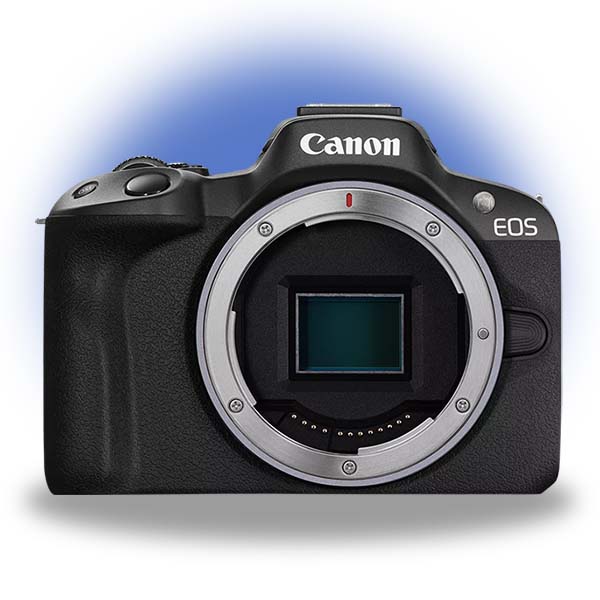
3. Canon EOS R50
The R50 is a crop sensor camera with a number of high end features that makes it a lighter and more affordable option.
There are some benefits to shooting sports with a crop sensor and if they appeal to you then the R50 is a great option. Especially since you can get it for well under $1000.
A crop sensor camera gives you more reach with the same focal length lens compared to a full frame camera. The crop factor for Canon is 1.6x which means that a 100mm lens on a crop sensor camera will have the same field of view as a 160mm lens.
Additionally, crop sensor cameras are typically smaller and lighter which can be a big benefit if you want to make it a little easier to get through an entire game without more arm fatigue or back pain.
This is the kind of camera I would put in my bag to take to my kid’s soccer game when I didn’t want to take out the bigger camera body.
Now let’s take a look specifically at the R50…
Canon EOS R50 Tech Specifications
- Lens Mount: Canon RF
- Megapixels: 24.2
- Sensor Size: APS-C (1.6x crop) CMOS
- ISO Range: 100-32,000 (exp to 51,200)
- AF Points: Dual Pixel CMOS AF II (100% coverage)
- Continuous shooting speed: 12fps (15fps w/ electronic shutter)
- Stabilization: None
- Viewfinder: EVF, 2.36m dots, 60fps refresh rate, 0.95x magnification
- LCD: Fully Articulated 3-inch touch screen, 1.62m dots
- Max video resolution: 4K video up to 30p (no crop)
- Memory Card: 1 slot (SD/SDHC/SDXC UHS-I)
- Dimensions: (W x H x D): 116 x 86 x 69 mm (4.57 x 3.39 x 2.72″)
- Weight: 375g
The 24.2 megapixels is on par with the R6 Mk II and with the crop factor you may not have to crop in as much to get closeups of the athletes.
With a shooting speed of 12 fps with a mechanical shutter and 15 fps with the electronic shutter, you’ve got enough speed to capture fast moving action.
The viewfinder is a bit of a step down in both resolution (2.36m dots) and refresh rate (60fps) compared to the full frame options above, but this is something you might not even notice unless you compared both side by side.
Overall, this is a great budget option if you want to save some money and get started shooting sports photography.