Canon is the largest camera manufacturer in the world and has a huge range of cameras and lenses from beginner to pro. So if you’re a beginner then Canon cameras are a great place to start. But with a number of quality cameras, the choice can be difficult, especially without a lot of experience.
If you’re looking for a quick recommendation, the best Canon camera for beginners is the Canon EOS R50.
In fact, it compares well among the best cameras for beginners.
But depending on your specific needs, there are a few others you may want to consider, and a couple that I wouldn’t recommend. After using these cameras and teaching many beginners, here’s a full breakdown of the best Canon cameras for beginners…
Photography Goals uses affiliate links. When you buy products through the links on our site, we may earn a commission.
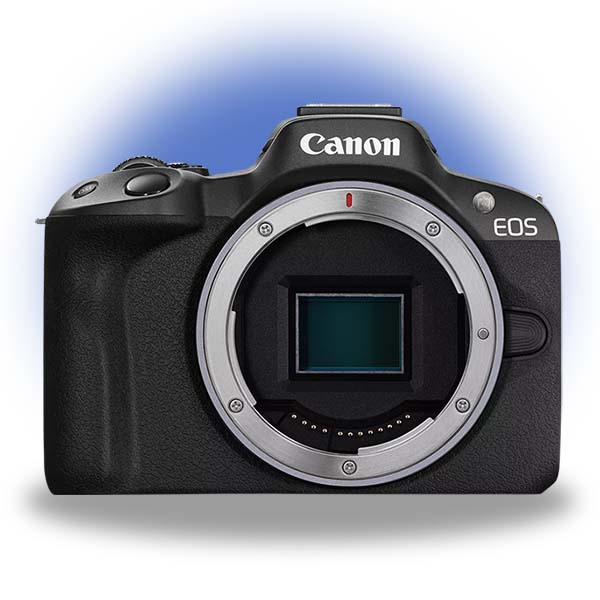
Canon EOS R50
The Canon R50 is an excellent entry-level Canon camera that’s affordable and a great way to get started with Canon’s Mirrorless RF Mount lens system and a great value.
The Canon EOS R50 is the perfect Canon camera for a beginner. It’s affordable, has a great feature set, is simple to use, and allows you to build up an RF system lens collection to match your skills as you improve.
Canon EOS R50 Tech Specifications
- Lens Mount: Canon RF
- Megapixels: 24.2
- Sensor Size: APS-C (1.6x crop) CMOS
- ISO Range: 100-32,000 (exp to 51,200)
- AF Points: Dual Pixel CMOS AF II (100% coverage)
- Continuous shooting speed: 12fps (15fps w/ electronic shutter)
- Stabilization: None
- Viewfinder: EVF, 2.36m dots, 60fps refresh rate, 0.95x magnification
- LCD: Fully Articulated 3-inch touch screen, 1.62m dots
- Max video resolution: 4K video up to 30p (no crop)
- Memory Card: 1 slot (SD/SDHC/SDXC UHS-I)
- Dimensions: (W x H x D): 116 x 86 x 69 mm (4.57 x 3.39 x 2.72″)
- Weight: 375g
The R50 is the camera I would recommend to beginners because it’s a great entry point to the Canon Mirrorless RF system. I wouldn’t buy a DSLR anymore because all of Canon’s newest gear is going to be part of the mirrorless system.
But it’s not the top pick just because it’s a mirrorless camera.
The R50 does a great job of combining a small and lightweight body with some solid ergonomics that Canon DSLR users will be used to. It’s basically a scaled-down version of a bigger Canon camera (which is a good thing).
But there’s more than just the small and well made body that makes this perfect for beginners.
It also has all the features that a beginner would need.
It has the same Dual Pixel CMOS AF II focusing system as the high-end Canon cameras. That means game changing features like eye autofocus for people and animals. If you’ve never shot a portrait with eye AF then you’ll be amazed how easy it is to get the eyes in sharp focus.
There are some negatives, though.
Because this is a crop sensor camera and has a less expensive sensor, the low light performance and dynamic range aren’t as good as the more expensive full-frame cameras. Of course, this is expected given the price difference.
If you want a camera that works great in low-light situations like indoor parties, natural light portraits after sunset, or evening street photography, then check out the full-frame RF below.
This camera will allow you to try a wide range of photography (depending on which lenses you pair with it of course) so you can figure out what you love shooting.
If you choose this lens then be sure to check out my breakdown of the best lenses for the Canon R50.
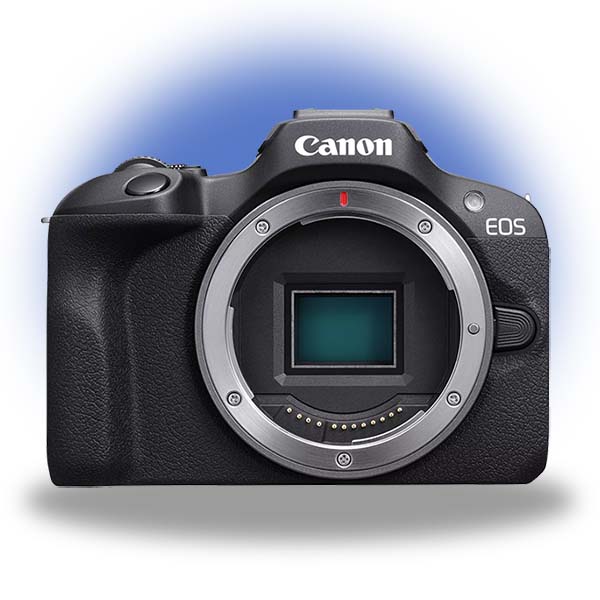
Canon EOS R100
Canon recently introduced this excellent entry-level mirrorless camera that is perfect for beginners on a budget that want to get into the Canon RF lens system.
The Canon R100 is the newest entry-level APS-C (crop sensor) mirrorless camera from Canon. It is a great entry point into the Canon RF system and an affordable way for a beginner to get started learning photography.
Canon EOS R100 Tech Specifications
- Lens Mount: Canon RF
- Megapixels: 24.1
- Sensor Size: APS-C (1.6x crop) CMOS
- ISO Range: 100-12,800 (exp to 25,600)
- AF Points: Dual Pixel CMOS AF (88% coverage)
- Continuous shooting speed: 6.5fps (3.5fps with AF)
- Stabilization: None
- Viewfinder: EVF, 2.36m dots, 60fps refresh rate, 0.95x magnification
- LCD: Fixed 3-inch (non-touch) screen, 1.04m dots
- Max video resolution: 4K up to 25p (1.55x crop), 1080p up to 60p (uncropped), 720p up to 120p
- Memory Card: 1 slot (SD/SDHC/SDXC UHS-I)
- Dimensions: (W x H x D): 116.3 x 88.1 x 58.7mm
- Weight: 356g with battery and memory card
The biggest draw for this camera is the price. As a beginner, you should be looking for the least expensive entry point into a good camera system and spend your budget on quality lenses. It’s easy to upgrade your camera as your skills outpace the functionality of the camera.
An important feature that is missing is a tracking focus mode. That’s when you have a focus point that you put over an object, press a button, and the camera tracks that object. This is essential for shooting moving subjects like wildlife, sports, or even just kids playing. Although for that last one, you can probably just use the eye AF tracking, which this camera does have (but it’s not quite as good as the R50 above).
Really, the best part of this camera is the price. It’s one of the lowest-priced mirrorless interchangeable lens cameras on the market. So at that price level, it’s hard to criticize Canon for the feature shortcomings.
But ultimately, if you can afford the extra cash for the R50, I think that is a much better option for beginners.

Canon EOS R10
The R10 is a crop sensor camera that is great for beginners that want a little more features than an entry level camera.
If you have the budget for it and want a camera that is great for a beginner that you won’t outgrow as quickly then the Canon EOS R10 is an excellent choice.
Canon EOS R10 Tech Specifications
- Lens Mount: Canon RF
- Megapixels: 24.2
- Sensor Size: APS-C (1.6x crop) CMOS
- ISO Range: 100-32,000 (exp to 51,200)
- AF Points: Dual Pixel CMOS AF II (100% coverage)
- Continuous shooting speed: 15fps (23fps w/ electronic shutter)
- Stabilization: None
- Viewfinder: EVF, 2.36m dots, 120fps refresh rate, 0.95x magnification
- LCD: Fully Articulated 3-inch touch screen, 1.04m dots
- Max video resolution: 4K 60p, 4K 30p (oversampled 6K), 1080p 120p
- Memory Card: 1 slot (SD/SDHC/SDXC UHS-II)
- Dimensions: (W x H x D): 123 x 88 x 83 mm (4.84 x 3.46 x 3.27″)
- Weight: 426g
This camera comes in at under $1000 for the body which is pretty good for a camera that has a lot of higher end features.
I would consider this a bit more of an intermediate crop sensor camera. You’ll get faster frame rates and a more professional user experience with this compared to the R50.
They are similar in specs but the R10 has more physical buttons and dials which may not seem important but as you shoot more, you’ll really appreciate being able to change your settings quickly on the fly without having to use the touch screen or menu functions.
The more that you can adjust using physical buttons and dials, the faster you can get back to shooting. This means less missed shots and typically better results.
The R10 also outperforms the R50 a bit when it comes to video, letting you shoot 4k video up to 60p compared to the 30p of the R50. It also will let you record a little longer at the highest resolution compared to the R50.
Overall, you’re looking at a decent upgrade in all aspects compared to the R50 but that also means the R10 costs about $300-400 more than the R50. So if you have the budget and want a camera that you won’t outgrow as fast, then this might be the right camera for you.

Canon EOS RP
This is the Canon camera I would recommend to beginner photographers if they know they’ll be shooting a lot in low-light situations and absolutely need the full-frame sensor.
The Canon EOS RP is one of the best “entry-level” full-frame cameras you can find. But the real question is whether you really need a full-frame camera as a beginner.
Canon EOS RP Tech Specifications
- Lens Mount: Canon RF
- Megapixels: 26.2
- Sensor Size: Full-Frame Dual Pixel CMOS
- ISO Range: 100-40,00 (exp to 50-102,400)
- AF Points: Dual Pixel CMOS AF (88% coverage horizontally and 100% vertically)
- Continuous shooting speed: 4 fps with continuous AF (5 without)
- Stabilization: None
- Viewfinder: EVF, 2.36m dots, 60fps refresh rate, 0.7x magnification
- LCD: Fully Articulated 3-inch touch screen, 1.04m dots
- Max video resolution: 4K up to 24p, 1080p up to 60p
- Memory Card: 1 slot (SD/SDHC/SDXC UHS-II)
- Dimensions: (W x H x D): 133 x 85 x 70 mm (5.24 x 3.35 x 2.76″)
- Weight: 485g
If you don’t know what “full-frame” in a camera means then you’re probably not going to benefit from spending the extra money for this camera.
Now that we get that out of the way, let’s talk about why this is the best full-frame Canon camera for beginners.
As a beginner, it’s important to realize that most of your budget should be spent on lenses rather than camera bodies. You can get a lot farther by investing in high quality glass that is suited for the type of photos that you want to shoot rather than expensive cameras.
But there are some drawbacks.
Yes, the full frame sensor may give you better image quality than the crop sensor options above, but you’re only getting 4 frames per second burst shooting and a max of 24p when shooting 4k video.
If you know you’ll be shooting a lot of portraits or shooting in low light and don’t need a fast burst rate, then going full frame with the RP could work out well for you.
This isn’t necessarily the first camera I would recommend for beginners as it really is a professional-level camera, but if you’re not worried about budget and want a full-frame camera for improved low-light performance, then this would be a great option.
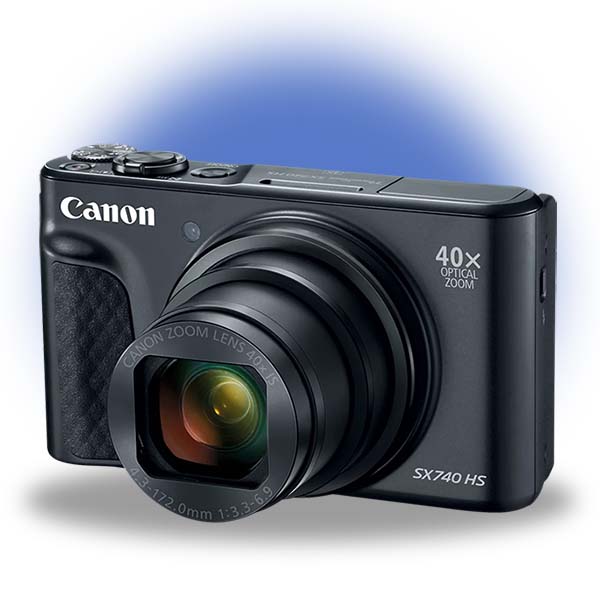
PowerShot SX740 HS
If you are looking for the most compact option that still has manual controls and will allow you to learn photography, this is a good option but you would probably be better off with any of the other options here.
I’ve included the Powershot SX740 HS here at the end because I know some of you aren’t ready to take the plunge into the world of interchangeable lens cameras but still want to learn the fundamentals of photography.
There are some point-and-shoots in the Canon lineup, that don’t have full manual control. Thankfully, this isn’t one of them, which makes it an excellent choice for beginners to learn with.
A major downside to going with a camera like this is that it shoots in JPEG only. Shooting in RAW makes a huge difference in the quality of your images and also gives you more adjustment range when you