


Shooting wildlife is both exciting and challenging. It usually requires longer focal-length lenses so you can capture close shots of the wildlife without having to get close to them.
Wildlife photography also means shooting in varying light conditions such as the low light of sunrise or sunset, so it’s also important to have wide aperture lenses to let in as much light as possible.
This means that choosing Nikon lenses for nature photography can be tricky and can get expensive.
I took a close look at the Nikon lens lineup and came up with 7 of the best Nikon lenses for wildlife photography including some that won’t break the bank. My favorite here was the Tamron 70-200 f/2.8 G2.
Here’s how the top picks break down so you can find the right one for your needs.
Best Nikon F-Mount Lenses For Wildlife

1. Tamron 70-200mm f/2.8 G2
The 70-200mm f/2.8 is the most used lens for sports and Tamron’s G2 version is every bit as good as the Nikon at half the price.
Although there are undoubtedly some excellent Nikkor lenses available to meet your wildlife photography needs (we’ll talk about those later in this article), the best bet for most wildlife photographers is the Tamron 70-200mm f/2.8 G2. Designed for FX bodies, it also works with DX bodies where its zoom range changes to 140-300mm.
The focal length offered by this high-end piece of glass maintains its maximum 2.8 aperture throughout the zoom range which means that you’ll have no problem capturing wildlife, even in low light conditions. Even in normal light conditions, the need to freeze fast-moving animals means using high shutter speeds or facing blurry images.
These factors coupled with Tamron’s innovative VC optical image stabilization system, which can compensate for up to 5 full stops (for stationary subjects), give you lots of rapid-fire hand-held freedom for a variety of wildlife shooting situations.
You can also add Tamron teleconverters to increase the reach of this lens to 400mm. This is helpful for wildlife that requires more reach like bird photography, for example. Just keep in mind that the aperture is cut by a proportional amount so a 2x teleconverter will give you a maximum f/5.6 aperture.
With so much to offer and user-confirmed great performance, the Tamron 70-200mm f/2.8 G2 just makes sense.
At $1300 MSRP, it’s still an investment piece but also basically half the price of an equivalent Nikkor glass—and offers at least 95% of the performance. This is the first lens I would put in my bag to shoot wildlife.

2. Nikon 70-300mm f/4.5-5.6 ED VR
Although this isn’t the sharpest or fastest wildlife lens Nikon offers, it will get you the reach of 300mm at an affordable price.
At roughly $500 MSRP, you can expect that this lens does make some sacrifices. However, it remains a solid piece that will up your sports photography game considerably.
One of this lens’s most attractive features undoubtedly is its wide zoom range extending all the way out to 300mm, bringing you closer than ever to your rapidly moving target to capture those unforgettable sports moments.
Designed to be a compact lens that offers more hand-held shooting possibilities, this lens includes Nikon’s upgraded Vibration Reduction II technology to compensate for up to 2.5 stops of camera shake.
This means that you can have more freedom to shoot in less-than-ideal lighting conditions that some other telephoto lenses can’t handle. But keep in mind that vibration reduction only helps to combat hand shake, it won’t freeze fast-moving subjects.
NOTE: There is a much less expensive model of this lens without VR that I don’t recommend. So be careful and use the links above to make sure you get the right one.
Unfortunately, in order to achieve being friendlier on the wallet and less bulky, the Nikon 70-300mm f/4.5-5.6G ED IF AF-S VR sacrifices aperture. With a maximum aperture of f/4.5 at 70 mm and f/5.6mm at 300mm, this is not a prime lens and you will likely note its limitations if you frequently shoot wildlife in very dimly lit spaces.
The smaller f-stops for focal length mean that it will be difficult to get the fast shutter speeds needed to freeze action. So speedy wildlife can be difficult to capture with this lens, especially in lower light.
3. Nikon DX 55-300mm f/4.5-5.6G ED
An affordable crop sensor (DX) option that has great reach at 300mm but some compromises such as the f/4.5-5.6 variable maximum aperture and some sharpness.
A similar option to our budget FX pick but designed specifically for DX body cameras, the Nikon AF-S DX NIKKOR 55-300mm f/4.5-5.6G ED VR offers practically the same benefits in a smaller and less expensive package than the full-frame version.
Reaching out to 300mm at the long end, this lens makes getting close to wildlife more affordable than you might have expected.
Thanks to the sacrifices made with regard to the aperture, this lens is rather compact and not too weighty which makes it friendly on the back when you’re out shooting or hiking for several hours. Obviously, you can expect to lose the advantages offered by a wider aperture that makes for faster shooting with clearer results.
However, at only $400 MSRP, that may not be a deal-breaker for many shooters. Despite its limitations, this lens is quite capable of producing great wildlife images.
This piece of glass also includes the Silent Wave Motor for more accurate and responsive autofocusing. Additionally, Vibration Reduction technology helps control camera shake.
You may find some degree of aberration in shots taken at 300mm, but it is not extreme and outperforms many other lenses in this same price range.
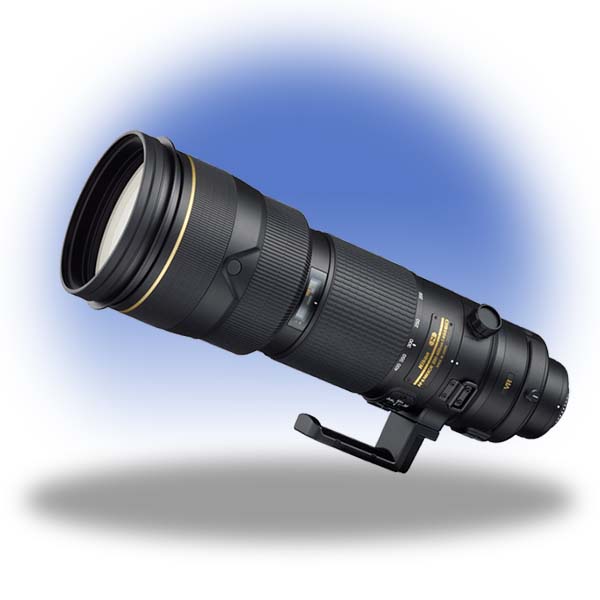
4. Nikon D200-400mm f/4 AF-S ED VR II
When you need a lens longer than 200mm, it’s time to invest in a larger and more expensive lens. The Nikon 200-400mm f/4 is an excellent option for this focal range and will give you a lot more reach.
For wildlife adventures where a 70-200mm telephoto lens isn’t enough, your best option may be the Nikon AF-S NIKKOR 200-400mm f/4G ED VR II.
This impressive piece of professional-grade glass lets you get up close and personal with your wi